
Behind the Scenes with PromoVeritas: Q&A with Jeremy Stern
by Di · Published · Updated
If you enter competitions regularly, you may well have seen the name PromoVeritas pop up in the terms & conditions! They’re the independent verification team behind big promotions for brands like Cadbury, Walkers, and O2. They write the T&Cs, conduct secure draws, judge creative competitions, hide ‘golden tickets’, and ensure brands run their prize promotions fairly.
I invited Jeremy Stern, CEO of PromoVeritas, to join me for a special Legends Live broadcast, where he answered questions from the SuperLucky community. I’ve included some of his answers here, and Lucky Legends members can watch the full replay of the interview at www.superlucky.me/legends-live.

What do PromoVeritas do?
PromoVeritas literally means “truth in promotions.” We ensure everything is safe, legally compliant, and fair. We act on behalf of the brands to protect their reputation (so they don’t end up in the Daily Mail!) and also for the public so that you can trust the process. We run over 2,000 projects a year across 80 countries. A typical prize draw receives between 20,000 and 40,000 entries but it really depends on the communication, the ease of entry, and whether it’s advertised on TV.
How difficult is it to run competitions across different countries – are the laws very different?
Incredibly different! In the UK we are lucky; we have some of the easiest promotional laws in Europe and no tax on prizes for winners. In Italy, you have to go to the government weeks in advance for approval, a public official conducts the draw, unclaimed prizes must go to charity, and winners pay tax. In Greece, if we give away a €10,000 prize, we actually take the tax out first and pay the winner €9,000.
What kind of sales increase does a brand hope to see from an on-pack promotion?
I used to be the Promotions Director for Coca-Cola North West Europe. If we achieved a 0.5% to 1% increase in sales, we were applauded! For a billion-pound brand, that 1% increase could be £10 million. However, most brands don’t actually run promotions just to get your data or directly increase sales. They do it to buy favours with supermarket buyers. Running a massive competition gets them the “gondola ends” (prime promotional spaces at the end of aisles), and simply being in that space is what increases their sales.
Why are there strict entry limits on so many on-pack promotions?
Entry limits are tied to health regulations. Brands are terrified of being accused of promoting unhealthy eating habits or childhood obesity by encouraging people to bulk-buy chocolate or crisps just to get a football or win a holiday! Also, with the new “less healthy food and drink” laws, chocolate and crisps can’t be placed within four metres of a shop entrance or till. To get around this, brands like Cadbury and Mars are now paying for their own massive branded display fixtures in the middle of the aisles, where they feature their prize promotions.
Do brands only run promotions to collect email addresses?
Actually, having 100,000 pieces of your data is very annoying for a brand! If they start to do anything with it such as emailing, it costs them money, and most don’t have the budget for direct marketing. Our default is “less is more.” We don’t even ask for your gender or title on our forms. And legally, if you do get sent an email, there must be a working unsubscribe button.
Is there a secret “blacklist” of compers who break the rules?
Let me be clear: there is absolutely no ongoing “blacklist” of naughty people used across different promotions. We can’t act as judge and jury – you might have broken a rule on one promotion, but be totally genuine on the next. We judge every entry on its own merits.
How do you spot third party and fake entries?
We make a clear distinction between “compers” (who follow rules but enter in volume) and “scampers” (who use fake IDs, aliases, or enter for every member of their family). We use IP checkers, but we know they aren’t perfect because a whole office of 50 people could share one IP address. Instead, we treat it like a house alarm. If just one trigger goes off (like a shared IP), we don’t disqualify. But if two triggers go off – for example, we once had 373 entries coming from one tiny council estate in Hounslow! – that flags as suspicious. This is also why we use one-time text codes; to stop people using ten different phones to game the system.
What is the most ridiculous story of someone getting caught out?
We ran a Bacardi competition to win a trip to Cuba. We drew the winner, rang the number, asked to speak to Mary, and they put a three-year-old child on the phone! Mary’s grandmother had put down every member of the family to get extra entries, so we had to disqualify them. We also had a 16-year-old win a bicycle on an 18+ promo; we contacted his mother to make sure it was okay for him to receive it, but we were absolutely within our rights to disqualify him. Breaking T&Cs is technically obtaining goods by deception, which is fraud.
Why don’t promoters ask us to upload our receipts at the point of entry rather than asking for them after winning?
It’s down to budget again, as it can cost about 10p to process each receipt. When we do check receipts, we use OCR (Optical Character Recognition) technology. It scans the receipt for unique data points and assigns it a numerical score. If a receipt comes up with the exact same score later, it gets flagged as a duplicate for a human to check.
How do “Winning Moments” actually work? Are they completely random?
Unless the terms say otherwise, we generate the winning moments randomly across the entire promotional period. There might be no winners on Tuesday, and ten winners on Wednesday – but that’s randomness for you! But sometimes the terms will specify that there is one WM a day, in which it could be anywhere within the stated hours, usually 24 hours but sometimes 8am to 8pm or similar. We also use an “on or first after” mechanic. If no one enters at the exact winning moment, the prize remains available for the very first person who enters after that moment. We do not like schemes where the prize is only awarded if someone enters exactly on the WM – highly unlikely and mildly deceptive.
What happens to unclaimed prizes?
If a prize goes unclaimed in the UK, it typically goes to a reserve winner. However, international laws are wild – for a Polaroid promo in Italy, we had to donate 1,000 phone cases to a local cat charity because of the law!
Why are there so many merchandise and ‘tat’ prizes – surely these don’t meet a brand’s sustainability targets?
Sometimes brands simply have stock in their warehouse they need to clear! At PromoVeritas we like to add a hand-signed letter from the brand when we send the physical prizes, so even if you only won a t-shirt, you feel like a brand ambassador.
When you need to ‘seed’ a winning product for a ‘Golden Ticket’ style promotion, how do you decide where they go?
We look at the brand’s sales data. If Scotland buys 25% of all Cadbury Creme Eggs, then we will hide 25% of the winning eggs in Scotland. If Tesco sells 10% of the volume, they get 10% of the winners. For high-volume, low-value prizes (like dropping £5 notes into biscuit packs), we do it at the factory. But for high-value prizes, our team travels the country secretly placing them on shelves! My favourite was taking a cruise up the coast of Norway on the Hurtigruten ferry, hopping off at every port to secretly place winning chocolate bars in local shops.
Do all the winning products actually get found?
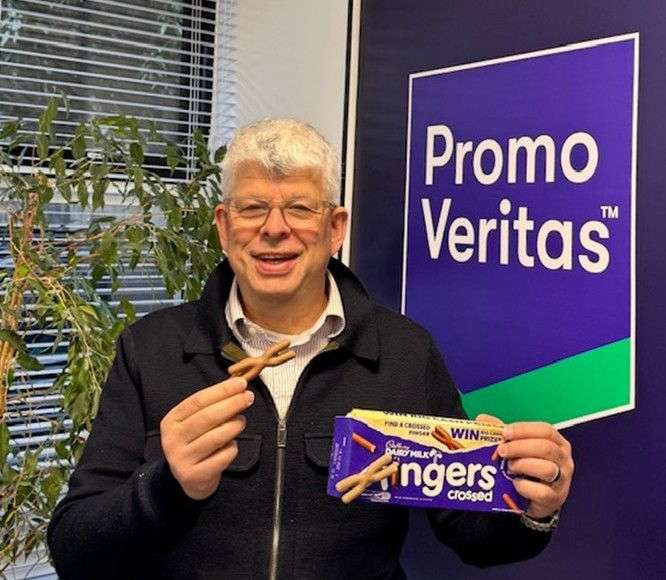
We typically only see about 70% to 75% of “Golden Ticket” style prizes successfully claimed. Sometimes the product gets damaged in-store, thrown away when it goes out of date, or people simply eat them without checking the wrapper. When you see someone in the press claiming they ate the special Cadbury Crossed Fingers or Creme Egg, and they’re gutted they missed out on the prize, that’s nonsense – the winning packaging always has a ticket in to confirm it’s the winning product, and with instructions on claiming the prize. We saw another agency run one promotion for a sweet brand which was sold in cinemas, where the sweet was a different shape – not a good idea; you don’t want a ten year old munching away in the dark and eating the winning sweet without realising they’ve won a prize!
There are rumours PromoVeritas is working with Raffle/Pay-to-Enter sites. Is this true?
For the last 4 or 5 years, we have run the draws for BOTB (Best of the Best) to keep them on the straight and narrow. However, we cannot say the same for the rest of that sector. They call themselves “competitions,” but it’s really a form of gambling. We are highly dubious about whether they actually award the big prizes if they don’t sell enough tickets, and the “free postal entry” routes are often extremely sneaky.
Do you still verify TV phone-ins and votes?
We have done the vote verification for the ITV National Television Awards for 14 years, and others for a certain national broadcaster. For the NTAs, voting closes at 3pm on the day, and we sit behind the scenes at the O2 Arena with a stack of winning plaques. Since we don’t know who will win until the very end, we have plaques ready to go for EastEnders, Coronation Street, and Emmerdale, and we secretly attach the right one to the trophy at the last second!
Should I answer calls from unknown numbers?
Always take a chance on them! Generally, if a winner is going to be telephoned, it will say so in the terms and conditions. When we call a winner it will show as an unknown number – and we won’t leave a message. That’s because if we left a message on your phone, but you’re away and don’t check your messages, you may miss out on the claim period and the prize awarded to a reserve winner.
Thank you so much for taking the time out to answer all these questions Jeremy – it’s been a fascinating look behind the scenes!
For more information visit www.promoveritas.com – and you can also search for your name at www.promowinners.com to see if you’ve won any of their comps!


Thanks for sharing this Di – I woder if Jeremy enters comps himself.
When I first started entering comps in the late 1970s there was a ‘Handling House’ with the postcode KT22 I think which always stuck to the rules – the main man was called Ray but I could be wrong.
There was another handling house that mostly seemed to choose winners from prize draws – it was in West Sussex maybe Pulborough?
A local Observer Series paper said it was no using postcards larger than a standard picture view as the ‘hat’ was too small so they would be binned.
I won a super posh break from a Cat/Dog food comp and I was chosen the winner because the editor of the the then Evening Argus loved my cut down cat birthday card. Ford Prison won the dog food – so not random draw in my case. x
We asked Jeremy whether he enters comps and he said he doesn’t!