
Vote-farming: cheating or not?
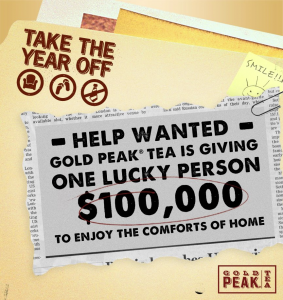
The New York Times reported the story on Monday and the Huffington Post followed soon after. The Gold Peak Tea Facebook page is full of angry messages of support for Theodore whilst over at NY Times they’re delighted that a lawyer got his comeuppance for not following the rules.
I blog regularly about the problems with voting contests, and decided to find out exactly what had happened. Take a look at Theodore’s post on the Sweepstakes forum:
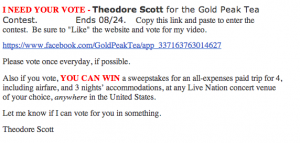
(note: the Live Nation prize for voters was offered by Gold Peak Tea, NOT by Theodore himself – which would have been an indisputable reason to disqualify him!)
The rules of the contest stated:
Finalists are prohibited from obtaining votes for any Submission and Video by any fraudulent or inappropriate means, including, without limitation, offering prizes or other inducements to members of the public, vote farming, or any other activity that artificially inflates such Finalists’ votes as determined by Sponsor in its sole discretion.
And here’s where the problem lies – deliberately vague terms and conditions that can be manipulated in whichever way the promoter chooses. In this case, Gold Peak Tea (a Coca-Cola brand) considered that Theodore’s post on the forum was inducing people to vote with the offer of return votes for the 250+ respondents. In a statement on his Facebook page Theodore says: ‘The members of this Voter Request Forum are friends helping and supporting one another… If they voted for me, they did so out of their own volition; if I voted for them, I did out of mine’. Also on the Stand for Justice (Go Team Theodore) Facebook page we’re told that three of the five finalists broke the rules – two videos were over the 60 second limit stated in the terms. And the eventual winner of the $100,000, Michael Simpson, apparently submitted a video which breached copyright and according to the rules, should never have been approved. So why weren’t these entrants disqualified too?
Personally, I think Theodore should have won the contest. Many people think vote farming (or vote exchanging/swapping as we call it in the UK) is cheating, but I think it’s acceptable – when it’s ONE vote swapped with one REAL person. It might not be very fair – but I don’t think it should be classed as ‘cheating’. If your hobby is comping/sweeping then once you’ve exhausted the votes from family and friends, it’s clear that the best place to go is to a comping forum or Facebook page and ask for help. And to offer return votes is simply good manners. If you’ve been in a voting competition you’ll know how stressful it is when you’re near the end and are desperate to keep up – I’ve posted in friendly vote swap groups like the About.com forum in the past (although these days I don’t enter ANY voting competitions at all). BUT I would not go near these groups if the terms and conditions even vaguely hinted that vote farming would result in disqualification. It’s just not worth it, and I’m surprised that Theodore risked it, especially being a lawyer! It was a foolish mistake to make and he should have checked with the promoter first.
It bewilders me that so many promoters don’t even mention how entrants can collect votes in their Terms and Conditions. There are so many ways for people to cheat – buying votes, or setting up/buying fake Facebook accounts to use for multiple vote swapping for a start. Then there’s the voting sabotage and the groups that contact entrants with a guarantee that they’ll win the contest for them in return for a share of the prize. I suppose many promoters wonder where they should draw the line between what’s acceptable and what’s not – so they don’t even bother trying! But that’s not fair at all on the entrants, who are entitled to a set of clear, detailed rules to follow.
The only solution is to COMPLETELY STOP PUBLIC VOTING in contests, and I do think that gradually many promoters and PR agencies are coming round to this idea. Just this week Virgin Holidays, Appliances Online and Oak Furniture Solutions have all ditched voting in favour of judging their competition winners, which is great news.
Finally, compers take note – this story is an important reminder to ALWAYS READ THE RULES CAREFULLY. If something isn’t clear, ask for clarification. And promoters, this is yet another wake-up call – check my post on TEN REASONS WHY VOTING COMPETITIONS ARE A BAD IDEA for more advice.


